



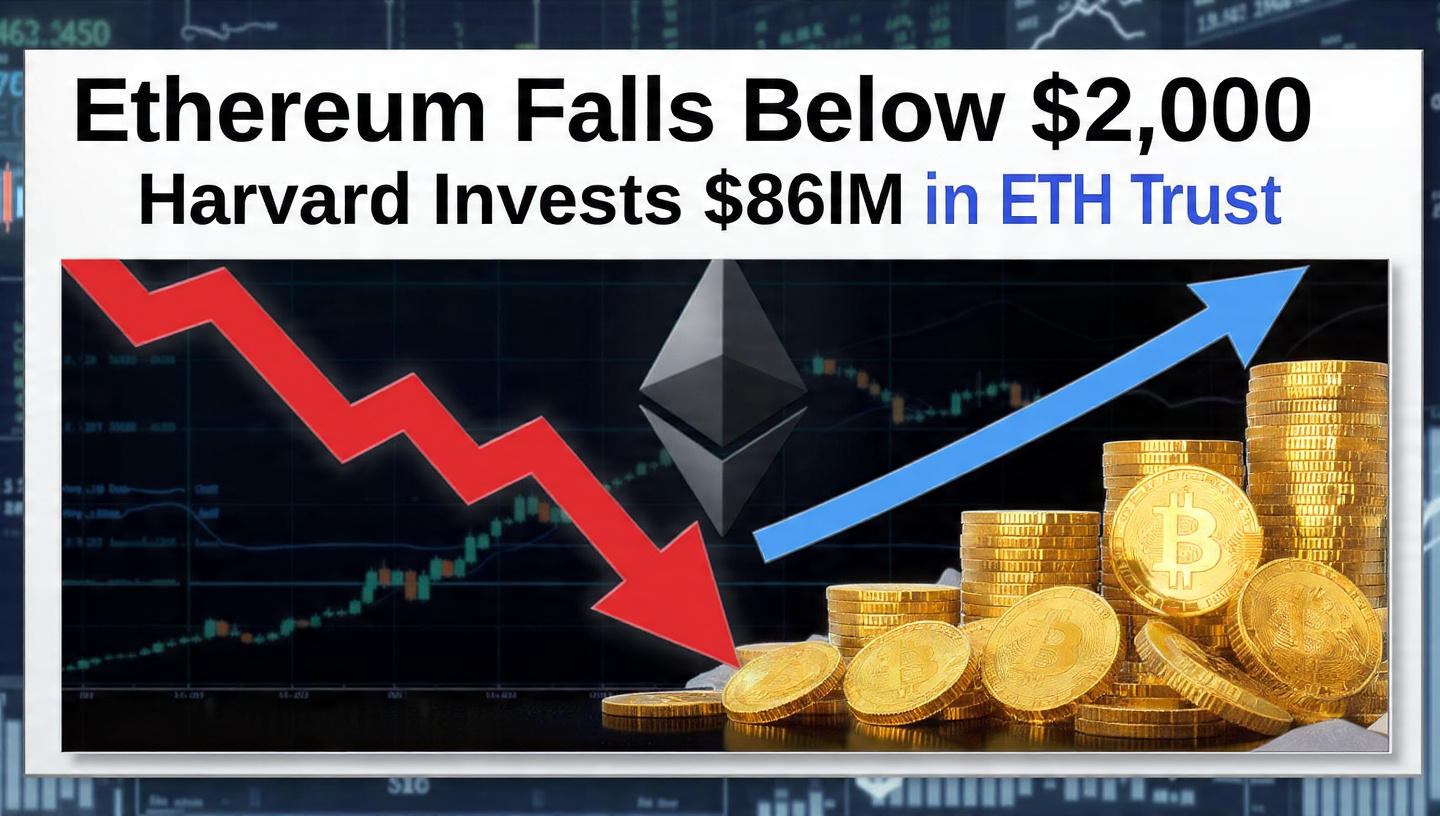
The cryptocurrency market has seen significant volatility recently, with Ethereum (ETH) dropping below the $2,000 mark.
This price movement has sparked discussions among investors, analysts, and institutional players regarding the broader implications for the crypto ecosystem.
Despite the short-term dip, institutional interest in Ethereum continues to grow.
Harvard University’s endowment recently invested $86.8 million into an Ethereum trust, signaling confidence in the long-term potential of the blockchain network.
At the same time, so-called “whales,” or large holders of ETH, appear to be accelerating accumulation, suggesting a growing belief in Ethereum’s future value.
These simultaneous trends of price decline and strategic investment highlight the complex dynamics currently shaping the cryptocurrency market.
Ethereum Price Movement and Market Context
Ethereum’s recent drop below $2,000 comes amid a broader market correction affecting major cryptocurrencies.
Factors such as regulatory scrutiny, macroeconomic pressures, and shifting investor sentiment have contributed to increased volatility.
Despite this decline, Ethereum remains one of the most widely adopted blockchain platforms, powering decentralized finance (DeFi), non-fungible tokens (NFTs), and numerous smart contract applications.
Analysts note that price corrections are not uncommon in crypto markets and often present buying opportunities for long-term investors.
Historically, Ethereum has experienced multiple price cycles, with temporary dips followed by significant recoveries.
Market watchers suggest that while the current downturn may be concerning to some, institutional adoption and strategic accumulation could support future growth.
Harvard University’s $86.8M Investment
One of the most notable developments in the Ethereum ecosystem is Harvard University’s recent investment.
The university’s endowment committed $86.8 million to an Ethereum trust, reflecting a strategic move into digital assets.
This investment is significant not only for its size but also because it underscores increasing institutional confidence in blockchain technologies.
Educational institutions and large funds have traditionally been cautious about cryptocurrency, making Harvard’s move particularly noteworthy.
By investing in an Ethereum trust rather than direct ownership, Harvard can gain exposure to ETH without managing private keys or taking custody of the tokens themselves.
This approach provides a regulated and secure way for institutions to participate in the cryptocurrency market.
Whales and Accumulation Trends
Another important factor affecting Ethereum’s market dynamics is whale activity.
Whales are large holders of cryptocurrency who can influence market movements through strategic buying or selling.
Recent on-chain data indicates that whales are actively accumulating Ethereum, even as prices remain below $2,000.
This accumulation suggests that these investors perceive current prices as favorable entry points for long-term gains.
Whale activity can also create a stabilizing effect in the market.
By holding large quantities of ETH rather than selling during dips, these investors reduce the likelihood of further sharp declines and may support future price recovery.
Implications for Retail Investors
For retail investors, Ethereum’s current price drop and institutional interest present a nuanced scenario.
On one hand, the price decline can be seen as an opportunity to enter the market at a lower valuation.
On the other hand, cryptocurrency markets are inherently volatile, and short-term losses remain a possibility.
Investors should consider factors such as risk tolerance, portfolio diversification, and long-term strategy when making decisions.
Additionally, institutional participation, like Harvard’s investment, may signal confidence in Ethereum’s potential to remain a key blockchain platform.
This could encourage smaller investors to adopt a long-term perspective rather than reacting to short-term fluctuations.
Market Outlook and Future Trends
Looking ahead, Ethereum’s trajectory will likely be influenced by a combination of market sentiment, institutional adoption, and technological developments.
The ongoing transition to Ethereum 2.0, with its focus on energy efficiency and scalability, may further strengthen investor confidence.
Institutional adoption is expected to grow as more universities, funds, and corporations explore regulated ways to invest in ETH.
Meanwhile, whale accumulation and long-term holding patterns suggest that many investors are optimistic about Ethereum’s potential.
Analysts caution that external factors such as regulatory changes, macroeconomic conditions, and broader cryptocurrency market trends could impact price movements in the near term.
However, the combination of strategic institutional investment and continued on-chain activity indicates that Ethereum remains a central player in the evolving digital asset ecosystem.
Conclusion
Ethereum’s fall below $2,000 highlights the volatile nature of cryptocurrency markets.
Yet, Harvard University’s $86.8 million investment in an Ethereum trust and whale accumulation trends demonstrate ongoing confidence in the blockchain’s long-term potential.
For investors, these developments offer both cautionary lessons and potential opportunities.
Careful consideration of market conditions, institutional signals, and personal risk tolerance is essential when navigating the complex world of digital assets.
As Ethereum continues to evolve through technological upgrades and increased adoption, its role in decentralized finance, NFTs, and smart contracts remains pivotal.
Strategic investors and institutions alike appear to recognize this value, making Ethereum a key cryptocurrency to watch in 2026 and beyond.
